
For generations, grandmothers and elders in Indian households have offered pregnant women the same timeless advice: “Read good books, listen to calming music, and stay happy, because the baby is listening.” For a long time, the modern, industrialized world dismissed these practices as mere cultural superstitions or quaint traditional folklore. However, as modern medical technology advances, a fascinating paradigm shift is occurring.
Today, neuroscientists, epigeneticists, and developmental psychologists are discovering profound scientific truths hidden within these ancient practices. They are realizing that the womb is not just an incubator for physical growth, but the very first classroom for the human brain. This ancient practice of intrauterine education is known in Ayurveda as Garbha Sanskar.
In this comprehensive exploration on The Rhythm & Reason, we will delve deeply into the Garbhak Sanskar science. We will decode how this 5,000-year-old wisdom is much more than a set of cultural rituals—it is a highly sophisticated, scientifically backed framework for optimizing fetal brain development, emotional resilience, and overall well-being.
1. What is Garbha Sanskar? Decoding the Terminology
To understand the depth of the practice, we must first look at its etymology. The term is derived from Sanskrit, the ancient language of the Indian subcontinent.
• Garbha translates to “womb” or “fetus.”
• Sanskar translates to “educating,” “cultivating,” “purifying,” or “molding.”
Therefore, Garbha Sanskar literally translates to the education and cultivation of the mind and body of the child while it is still in the mother’s womb. According to ancient Ayurvedic texts like the Charaka Samhita and Sushruta Samhita, a child’s mental and behavioral foundation starts forming from the moment of conception. The ancient seers believed that 80% of a human being’s brain development and core personality traits are established in the intrauterine environment.
The Mythological Precedents
Indian mythology is rich with allegorical tales demonstrating the power of Garbha Sanskar. The most famous is the story of Abhimanyu from the epic Mahabharata. While in his mother Subhadra’s womb, Abhimanyu listened to his father, Arjuna, explain the complex military strategy of entering the Chakravyuha (a labyrinthine battle formation). Because his mother fell asleep before Arjuna could explain how to exit the formation, Abhimanyu only learned how to enter it—a skill he flawlessly executed years later on the battlefield.
While viewed by some as a myth, this story serves as a profound ancient metaphor for a concept that modern science has now proven: fetal learning is real.
2. The Modern Garbha Sanskar Science: What Happens in the Womb?
For decades, modern medicine treated the womb as a dark, silent, and isolated chamber. The fetus was viewed merely as a growing biological mass, incapable of sensory perception or memory until after birth. Today, 4D ultrasounds, fetal echocardiography, and neuro-imaging have completely shattered this assumption.
The Development of Fetal Senses
The Garbha Sanskar science aligns perfectly with the biological timeline of fetal development:
• By Week 16: The fetus begins to react to light.
• By Week 18 to 20: The auditory system develops. The baby can hear the mother’s heartbeat, the rushing of her blood, and the digestion of her food.
• By Week 24: The baby begins to hear sounds from the outside world. The mother’s voice becomes the most distinct and recognizable sound, traveling through her body directly to the amniotic fluid.
• By Week 27: The baby can respond to external stimuli, such as a sudden loud noise, with an increased heart rate or movement.
The Biochemical Connection: The Placental Bridge
Garbha Sanskar teaches that a mother’s thoughts directly affect the child. Modern endocrinology confirms this through the study of hormones. The placenta is the biological bridge between mother and child. It filters nutrients and oxygen, but it also transmits hormones.
When a mother is chronically stressed, anxious, or angry, her brain releases a cascade of stress hormones, primarily cortisol and adrenaline. These hormones cross the placental barrier. Studies have shown that sustained high levels of maternal cortisol can alter the architecture of the fetal brain, potentially leading to anxiety disorders, hyperactivity, and lower emotional resilience later in the child’s life.
Conversely, when a mother is joyful, relaxed, and engaged in positive activities (like reading or meditation), her brain releases “happy hormones”—endorphins, serotonin, and dopamine. These neurochemicals bathe the fetus in a biochemically positive environment, promoting optimal neural growth and a calm disposition. This biochemical communication is the very foundation of the Garbha Sanskar science.
3. Epigenetics: How Environment Shapes Genetics
Perhaps the most groundbreaking modern validation of Garbha Sanskar comes from the field of Epigenetics.
For a long time, the scientific dogma was that DNA is destiny. You inherit a set of genes, and those genes dictate exactly who you will become. Epigenetics (meaning “above genetics”) has proven this false. While you cannot change the actual DNA sequence you pass to your child, the environment dictates how those genes are expressed—which genes are turned “on” and which are turned “off.”
The womb is the baby’s very first environment. The food the mother eats, the air she breathes, and the emotions she feels create chemical “tags” that attach to the baby’s DNA.
• A calm, nutrient-rich, and positively stimulated womb environment can “turn on” genes associated with strong immunity, high cognitive function, and emotional stability.
• A toxic, highly stressed, or nutrient-deficient womb environment can “turn on” genes associated with metabolic diseases, stress sensitivities, and behavioral issues.
Therefore, Garbha Sanskar is essentially ancient epigenetic engineering. It is a proactive lifestyle approach designed to create the perfect biochemical and emotional environment to optimize fetal gene expression.

4. The Four Pillars of Garbha Sanskar
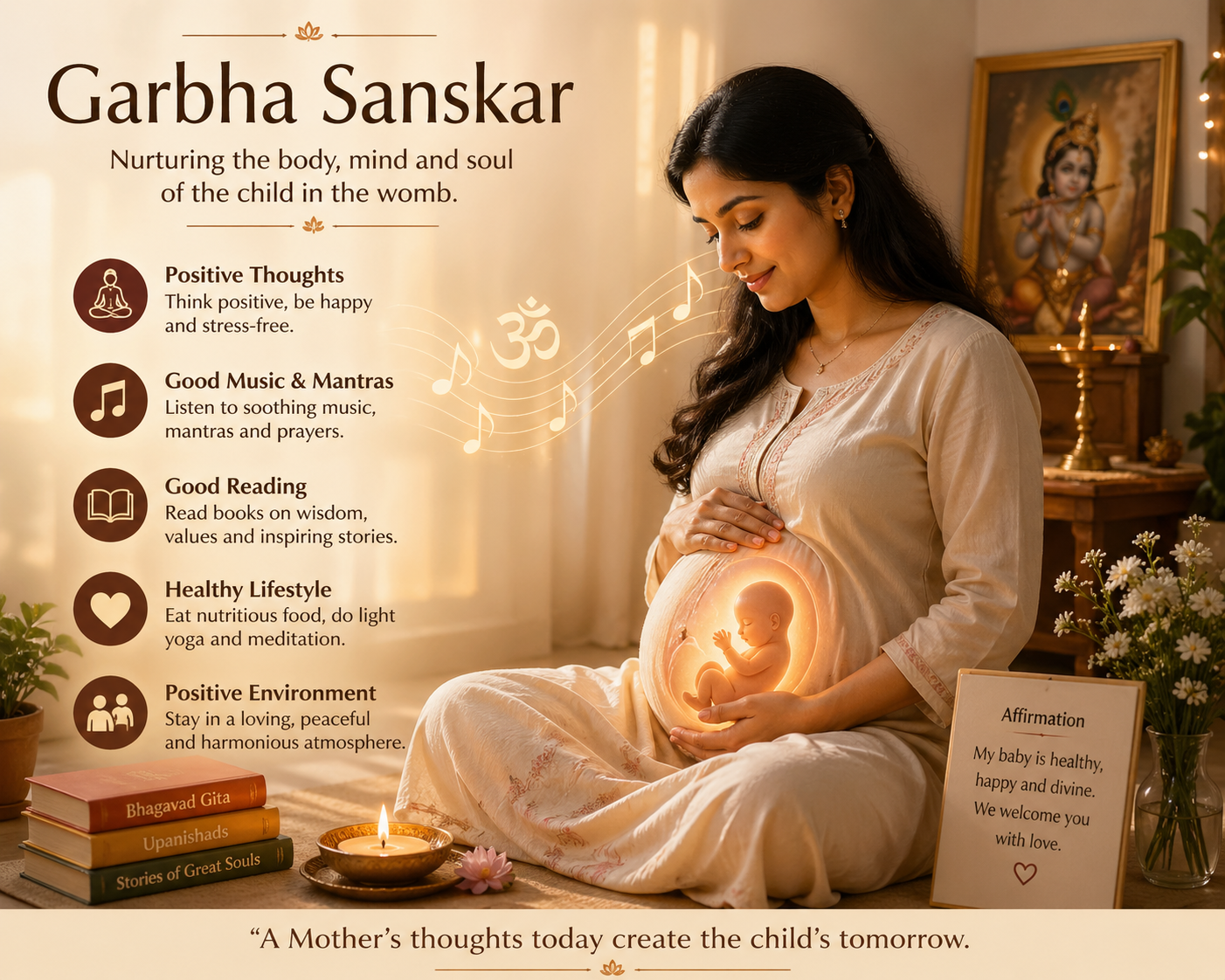
Authentic Garbha Sanskar is not just about listening to a specific music track; it is a holistic, 360-degree lifestyle. The ancient texts divide this prenatal education into four distinct pillars: Aahar (Diet), Vihar (Lifestyle), Vichar (Thoughts), and Aachar (Conduct).
Pillar 1: Aahar (Diet and Nutrition)
In Ayurveda, food is considered the first medicine. The Garbha Sanskar diet is fundamentally Sattvic—meaning it is pure, fresh, easily digestible, and mind-calming.
• What it includes: Fresh organic fruits, lightly cooked vegetables, whole grains, nuts, seeds, and A2 cow’s milk. Ghee (clarified butter) is highly revered for its ability to nourish the brain and nervous system of the fetus.
• What it avoids: Tamasic and Rajasic foods, which are excessively spicy, stale, heavily processed, or overly stimulating (like excessive caffeine). These are believed to induce lethargy or hyperactivity in the baby.
• The Modern Science: Nutritional psychiatry confirms that the gut microbiome heavily influences brain development. A diet rich in Omega-3 fatty acids, folic acid, and natural vitamins directly fuels the rapid creation of fetal neurons.
Pillar 2: Vihar (Lifestyle and Activity)
Pregnancy is not an illness; it is a natural physiological state. Garbha Sanskar encourages gentle, mindful physical activity to maintain blood circulation and flexibility.
• Prenatal Yoga: Ancient Yogic traditions (which we highly advocate here through our Parampara initiatives) offer specific asanas modified for pregnancy. Poses like the Butterfly Pose (Baddha Konasana) and Cat-Cow (Marjaryasana) open the pelvis, reduce lower back pain, and prepare the body for a smooth delivery.
• Pranayama: Conscious breathing techniques, such as Anulom Vilom (alternate nostril breathing), increase the oxygen supply to the mother’s blood, which directly translates to a highly oxygenated environment for the fetal brain.
• Walking in Nature: Taking gentle walks in fresh air, preferably around trees and natural sunlight, helps regulate the mother’s circadian rhythm and boosts Vitamin D levels.
Pillar 3: Vichar (Thoughts and Mental State)
This pillar is the core of the psychological Garbha Sanskar science. The ancient sages dictated that a pregnant woman should protect her mind from negative influences.
• Positive Consumption: This means avoiding violent movies, distressing news, or toxic social environments. Instead, the mother is encouraged to read inspiring biographies, spiritual texts, or uplifting literature.
• Meditation and Visualization: Mothers are taught to sit quietly and visualize a healthy, intelligent, and compassionate baby. This mental visualization creates a placebo-like positive physiological response, lowering maternal blood pressure and inducing deep relaxation.
• The Modern Science: We now know that maternal stress shrinks the placenta, restricting blood flow to the baby. Positive Vichar (thoughts) directly counteracts this, ensuring the umbilical cord remains relaxed and vascularized.
Pillar 4: Aachar (Behavior and Conduct)
Aachar refers to the mother’s daily conduct and interactions with the world. Garbha Sanskar suggests that a mother should practice forgiveness, gratitude, and compassion.
When a mother engages in acts of kindness or speaks gently, she experiences a drop in stress levels. The baby, feeling this biochemical shift, begins to associate positive social behavior with physical comfort, laying the earliest neurological groundwork for empathy and emotional intelligence (EQ).
5. The Power of Sound: Music, Mantras, and Fetal Memory
One of the most popular aspects of Garbha Sanskar is the playing of specific music or the chanting of mantras to the unborn child. But does the baby actually care about Mozart or ancient Sanskrit chants?
The answer lies in the physics of sound and brainwave frequencies.
The Science of Vibration
Sound travels much faster and more efficiently through water (the amniotic fluid) than it does through air. When a mother listens to classical Indian ragas (like Raga Kalyani or Raga Yaman) or classical Western symphonies, the harmonious frequencies reach the baby’s developing auditory cortex.
• Sanskrit Mantras: Sanskrit is a highly phonetic and vibrational language. Chanting mantras like the Gayatri Mantra or the Om syllable creates specific harmonic resonances. These low-frequency vibrations stimulate the vagus nerve in the mother, instantly reducing her anxiety.
• Brainwave Entrainment: Listening to rhythmic, 60-beats-per-minute music can actually synchronize the brainwaves of both the mother and the child, shifting them from a stressed Beta state into a relaxed Alpha state.
Fetal Memory and Language Acquisition
Modern studies have shown that babies are born already recognizing their mother’s voice and the native language spoken around them during the third trimester. A famous study demonstrated that babies will suck on a pacifier more vigorously when they hear a story that was repeatedly read to them while in the womb, compared to a totally new story.
By talking to the bump, reading aloud, and playing soothing music, parents are actively stimulating the synaptic connections in the fetal brain, giving the child a massive head start in cognitive development and language processing.
6. How to Practice Garbha Sanskar in the Modern World
You do not need to retreat to an ancient ashram to practice Garbha Sanskar. It is highly adaptable to the modern, busy lifestyle. Here is how modern parents can integrate this ancient science into their daily routines:
1. The 15-Minute Connection Rule: Dedicate 15 minutes every night before sleep to disconnect from all digital screens. Place your hands on the belly, take deep breaths, and simply talk to the baby. Tell the baby about your day, your hopes, and your love.
2. Curate Your Feed: We are what we consume. During pregnancy, actively unfollow toxic, anxiety-inducing news channels or social media accounts. Curate your digital environment to feature humor, art, nature, and positivity.
3. Mindful Eating: Instead of eating on the run or while staring at a laptop, sit down for meals. Eat slowly, chew thoroughly, and express gratitude for the nourishment. This mindful eating optimizes digestion and nutrient absorption.
4. Engage the Father: Garbha Sanskar is not solely the mother’s responsibility. The father’s voice is typically lower in pitch, which travels exceptionally well through amniotic fluid. Fathers should read to the bump and, most importantly, ensure the mother is emotionally supported and stress-free.
Conclusion: Bridging the Ancient and the Modern
The profound Garbha Sanskar science proves that the ancient Indian seers possessed an intuitive understanding of human biology that modern medicine is only just beginning to quantify. They understood that a child is not merely constructed from biological material, but is woven from the thoughts, emotions, and environment of the mother.
Garbha Sanskar is far more than a cultural tradition or a religious ritual. It is the world’s oldest and most holistic prenatal education system. By combining the nutritional purity of Ayurveda, the mental discipline of Yoga, and the vibrational power of sound, parents can actively shape the physical health and psychological resilience of their future child.
In a world that often treats pregnancy merely as a medical condition to be managed, the wisdom of Garbha Sanskar invites us to view the womb as a sacred space of creation. It empowers parents with the knowledge that the education of a lifetime begins long before the first breath is ever taken.
Frequently Asked Questions (FAQs)
Q1: What is the exact meaning of Garbha Sanskar?
A: “Garbha” means womb, and “Sanskar” means to educate or purify. It is the ancient Ayurvedic practice of educating and nurturing the baby’s mind, body, and soul while it is still in the mother’s womb.
Q2: Is there actual science behind Garbha Sanskar?
A: Yes. The Garbha Sanskar science is heavily supported by modern epigenetics and fetal neuroscience. Studies prove that a mother’s biochemical state (stress hormones vs. happy hormones) and environmental stimuli (sounds, diet) directly shape the structural development of the fetal brain.
Q3: When should a mother start practicing Garbha Sanskar?
A: Ideally, the preparation begins even before conception through a healthy lifestyle. However, specific prenatal practices like reading, listening to music, and talking to the baby become highly effective from the second trimester (around the 4th or 5th month) when the baby’s auditory and nervous systems begin to function.
Q4: Does listening to mantras really affect the baby?
A: Yes. Sound travels efficiently through amniotic fluid. The specific rhythmic vibrations of classical music and Sanskrit mantras lower maternal stress, induce deep relaxation, and stimulate the neuro-pathways in the fetal brain associated with language and memory.
Q5: Can working mothers practice Garbha Sanskar?
A: Absolutely. It does not require hours of complex rituals. It is about a holistic lifestyle. Simple acts like taking deep breaths during a busy workday, eating fresh food mindfully, avoiding toxic conversations, and spending 15 minutes talking to the baby at night are powerful Garbha Sanskar practices.
Medical Disclaimer: The information above is for educational and cultural purposes. Garbha Sanskar is a holistic practice and should be performed in coordination with professional medical advice from your doctor. Always consult your obstetrician before making changes to your diet or exercise routine.