
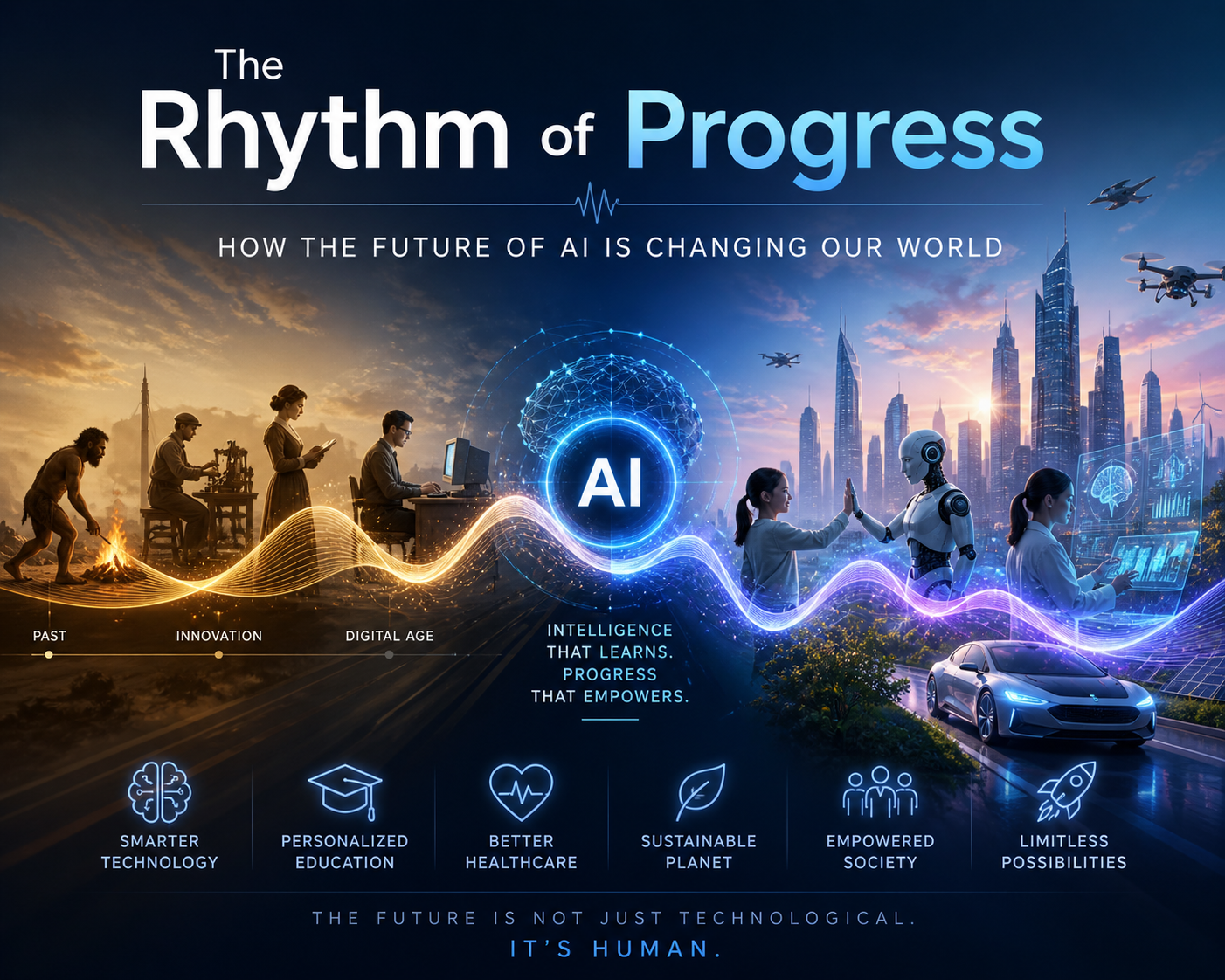
If we look closely at human history, every era has its own distinct “rhythm.” From the invention of the wheel to the industrial revolution, the birth of the internet, and the ubiquity of smartphones, every monumental step has accelerated the pace of our lives. Today, however, we are not just standing in front of another tool that makes us faster; we are walking alongside an invisible force capable of thinking, learning, and making decisions. That force is Artificial Intelligence (AI).
AI is no longer a concept confined to science fiction novels or futuristic movies. It has already become the fundamental pulse of our daily progress. From the moment we wake up to the notifications on our phones, to the movies we stream, the products we buy, and the medical diagnostics we rely on—everything is increasingly being shaped by artificial intelligence.
In this comprehensive exploration on The Rhythm & Reason, we will dive deeply into how the future of AI is reshaping the rhythm of our lives. How is it impacting our jobs, healthcare, education, and creativity? More importantly, how must we prepare ourselves to harmonize with this relentless wave of change?
1. Artificial Intelligence: More Than Just Technology, A Revolution
To understand the future of AI, we must first demystify what it currently is. AI is not simply about humanoid robots. The core objective of AI is to program computer systems to process information, analyze patterns, and learn from data in a way that mimics human cognitive functions.
The technology is broadly categorized into a few key areas:
• Machine Learning (ML): Feeding a computer massive amounts of historical data so it can learn to predict future outcomes without being explicitly programmed for every scenario.
• Deep Learning: A highly complex subset of ML that uses artificial neural networks modeled after the human brain. This is the technology that allows machines to understand speech, recognize images, and process natural language.
Until very recently, AI was primarily used for complex calculations and data sorting. Today, with the explosion of Generative AI (such as advanced language models and image generators), the technology is writing poetry, generating breathtaking artwork, composing music, and writing software code. AI is no longer just a tool; it is rapidly evolving into a digital co-pilot for humanity.
2. The New Rhythm of Employment and the Economy
The most common and pressing fear among the general public regarding the future of AI is: “Will it take my job?”
Job Displacement vs. Job Creation
It is an undeniable truth that highly repetitive, mechanical, and routine tasks will be fully automated by AI. Data entry, basic customer service (replaced by sophisticated chatbots), and certain assembly-line tasks in manufacturing may soon disappear. However, history is our greatest witness—whenever disruptive technology eliminates old jobs, it simultaneously creates new, often higher-paying, opportunities.
• The Jobs of Tomorrow: We are already seeing a massive surge in demand for AI Prompt Engineers, AI Ethics Managers, Data Analysts, and Robotics Maintenance Specialists.
• The Productivity Boom: A graphic designer, a financial analyst, or a software developer using AI can increase their work speed and output tenfold. The stark reality is not that AI will replace you, but rather, a person who knows how to use AI will replace the person who doesn’t.
From an economic perspective, the widespread adoption of AI is projected to add trillions of dollars to the global GDP over the next decade. Even small business owners can now leverage AI to market their products, analyze consumer behavior, and manage logistics at a level previously reserved for massive corporations.
3. The Pulse of Healthcare: AI as a Lifesaver
The transformations AI is bringing to the healthcare sector are nothing short of miraculous. The future of AI in medicine is not about replacing doctors; it is about giving them “superpowers.”
Precision Diagnostics
Long before an experienced radiologist might spot a microscopic anomaly on an X-ray or MRI scan, an AI model—trained on millions of historical scans—can detect the earliest, most invisible stages of tumors or cellular abnormalities. Early detection is often the difference between life and death in oncology.
Accelerated Drug Discovery
Historically, discovering a new chemical compound and bringing a viable drug to market took decades and billions of dollars. Today, utilizing advanced AI and supercomputing power, pharmaceutical companies can simulate and test millions of chemical compounds in a matter of days. This means new vaccines, targeted cancer treatments, and cures for rare diseases can be developed at an unprecedented speed.
Personalized Medicine
Every human being possesses a unique DNA structure, which means a “one-size-fits-all” approach to medicine is fundamentally flawed. By analyzing a patient’s genetic sequence, lifestyle habits, and historical medical records, AI can help doctors design highly personalized treatment plans that maximize efficacy and minimize negative side effects.
4. Education: The New Rhythm of Learning
Our current global education system is largely built on an industrialized model. A teacher delivers information at a single pace to a classroom of fifty diverse students. The future of AI promises to completely dismantle and rebuild this model.
• The Personalized Tutor: AI-driven educational applications can understand a specific student’s learning pace and style. If a student is struggling with a complex mathematical concept, the AI tutor will patiently provide alternative explanations, visual aids, and extra examples until the concept is mastered.
• Breaking Language Barriers: A student in a rural village can now access and fully comprehend the latest scientific papers from the world’s top universities. AI translation tools are becoming so advanced that they can instantly translate complex academic jargon into the student’s native language without losing the contextual meaning.
• Empowering Educators: By taking over heavy administrative burdens—such as grading multiple-choice exams, tracking attendance, and drafting initial lesson plans—AI frees up teachers to do what they do best: mentor, inspire, and spend quality one-on-one time with their students.
5. Creativity and Art: Does the Machine Have a Soul?
For centuries, we held onto a comforting belief: “Machines can calculate, but art, music, literature, and creativity are the exclusive domains of the human soul.” Generative AI has profoundly challenged this belief.
• Writing and Design: Today, AI can write engaging blog posts, design stunning corporate logos, and edit cinematic videos in a matter of seconds.
• Music Production: AI platforms can take a single sentence of text and generate a complete, studio-quality song, complete with vocals, instrumentation, and emotional inflection.
So, what is the future of the human artist? While AI can paint a technically flawless picture of a sunset, it does not understand the emotion behind it. An AI does not know the feeling of exhaustion after a hard day’s work, nor the profound peace of watching that sunset. Therefore, in the realm of creativity, AI remains a highly sophisticated brush. The soul, the intent, and the lived experience will always belong to the human artist.
6. Daily Life and Smart Cities
The future of AI will make our daily rhythm so seamless that its presence will eventually become entirely invisible to us.
• Smart Homes: Your home will anticipate your needs. The temperature will adjust before you arrive, the lighting will match your mood, and your refrigerator will automatically order groceries when you run low on essentials.
• Autonomous Vehicles: AI-driven transportation systems will drastically reduce traffic accidents caused by human error. Smart traffic grids managed by AI will optimize traffic lights in real-time, eliminating urban congestion and reducing carbon emissions.
• Reclaiming Time: By delegating mundane tasks to AI—like drafting routine emails, scheduling meetings, or paying bills—humans will reclaim the most valuable resource on earth: time. Time that can be spent connecting with family, pursuing hobbies, and enjoying nature.
7. The Warning Bell: Ethical Challenges and Risks
As with any monumental shift, the AI revolution casts a long and concerning shadow.
1. The Deepfake Dilemma: It is now incredibly easy to use AI to clone a person’s voice and map their face onto a fake video. This poses a massive threat to political integrity during elections, digital identity theft, and the spread of devastating misinformation.
2. Algorithmic Bias: AI does not think in a vacuum; it learns from the data we feed it. If our historical data contains racial, gender, or socioeconomic biases, the AI will inherit and amplify those prejudices. We have already seen instances where AI recruiting tools unfairly favored certain demographics over others.
3. Data Privacy: AI models require an unimaginable amount of data to function. Our personal information, photographs, search histories, and medical records are being aggregated by massive tech corporations, putting our fundamental right to privacy at severe risk.
4. Autonomous Weaponry: Perhaps the most dystopian risk is the development of autonomous military drones and weapons that can identify and engage targets without human intervention or ethical oversight.
Addressing these challenges requires immediate, unified global action to establish strict “AI Regulations” and ethical frameworks.
8. How Must We Prepare for This Future Rhythm?
The AI tsunami is here, and attempting to stop it is futile. Instead, we must learn how to surf the wave.
• Embrace Continuous Learning: The era where your education ended in your twenties is over. To thrive in the future of AI, we must adopt a mindset of lifelong learning. We must continuously familiarize ourselves with new software, AI tools, and technological trends.
• Cultivate Uniquely Human Skills: AI will beat us at logic, calculation, and data retrieval. Therefore, we must double down on what makes us human. Empathy, leadership, emotional intelligence, complex ethical reasoning, and critical thinking will be the most highly valued skills in the future job market.
• Adaptability: Those who can easily adapt to change will inherit the future. Instead of viewing AI as an adversary, we must view it as an instrument designed to elevate our potential.
Conclusion
The “Rhythm of Progress” never stops. Artificial intelligence is accelerating, expanding, and completely reshaping the rhythm of our future.
The most important takeaway is that AI is not a magic wand; it is a new instrument that humanity has invented. Whether we use this instrument to create chaotic noise or compose a beautiful, harmonious symphony for the world depends entirely on the hands of the conductor—us.
Machines will undoubtedly become smarter than us in many ways. But humanity, love, and the relentless search for reason and meaning reside exclusively within the human heart. Walking hand-in-hand with technology while fiercely protecting our human values—that is the true definition of progress.
Frequently Asked Questions (FAQs)
Q1: What exactly is Artificial Intelligence (AI) in simple terms?
A: AI refers to the capability of a computer system or machine to mimic human cognitive functions such as learning, reasoning, problem-solving, and making decisions based on data.
Q2: Will the future of AI destroy all human jobs?
A: No. While AI will automate repetitive and routine tasks, it will simultaneously create new, highly skilled jobs like AI prompt engineering and robotics maintenance. The people who will thrive are those who learn how to use AI to enhance their current work.
Q3: What is the biggest advantage of AI in the healthcare sector?
A: AI excels at analyzing massive amounts of medical data to detect diseases like cancer at incredibly early stages. It also speeds up the discovery of new drugs and allows for highly personalized medical treatment based on a patient’s specific DNA.
Q4: What are “Deepfakes”?
A: Deepfakes are synthetic, altered media where a person in an existing image or video is replaced with someone else’s likeness using sophisticated AI. They are often used maliciously to spread misinformation or commit cyber fraud.
Q5: How can ordinary people prepare for the AI revolution?
A: Keep an open mind and continuously learn how to use new AI tools. More importantly, focus on developing soft skills that machines cannot replicate, such as emotional intelligence, empathy, leadership, and creative problem-solving.
Disclaimer: The information provided in this article is for educational and informational purposes only. The Rhythm & Reason does not guarantee the absolute accuracy or performance of any third-party AI tools, software, or predictions mentioned. The future of technology is highly dynamic, and readers are encouraged to continuously educate themselves on the evolving landscape of Artificial Intelligence.
my opinion about AI is only we have money or we have knowledge than only we are happy in future otherwise!!!!!!!!
One question: If you could hand over one ‘boring’ part of your life to an AI agent today, what would it be?”
Recommended Reading from The Rhythm & Reason: Looking for inspiration to stay strong during tough times? Read theLife and Legacy of Swami Vivekananda.