

By Vishal
When I hit ‘publish’ on the Anna Hazare article here at The Rhythm & Reason just a short while ago, we discussed how the Aam Aadmi Party had strayed far from its original path. But tracking the news from my Bengaluru workspace today, I genuinely did not expect the political earthquake to hit this fast.
On April 24, 2026, the Aam Aadmi Party’s national ambitions didn’t just take a hit; they practically collapsed overnight. Raghav Chadha, long considered the poster boy of AAP’s youth wing, didn’t just resign—he engineered a massive defection, officially merging with the Bharatiya Janata Party (BJP) alongside six other Rajya Sabha MPs.
Let’s break down the sheer political math, the “toxic workplace” allegations, and what this massive shift means for the country.
Indian politics has always been a theatre of unpredictable twists and turns. However, a recent development in Delhi’s political corridors has captured the attention of the entire nation. That is the Raghav Chadha BJP Move. The Aam Aadmi Party (AAP), born out of the dream of a corruption-free India, has suffered an earthquake as its most influential young leader, Rajya Sabha MP, and national face, Raghav Chadha, has officially joined the lotus camp.
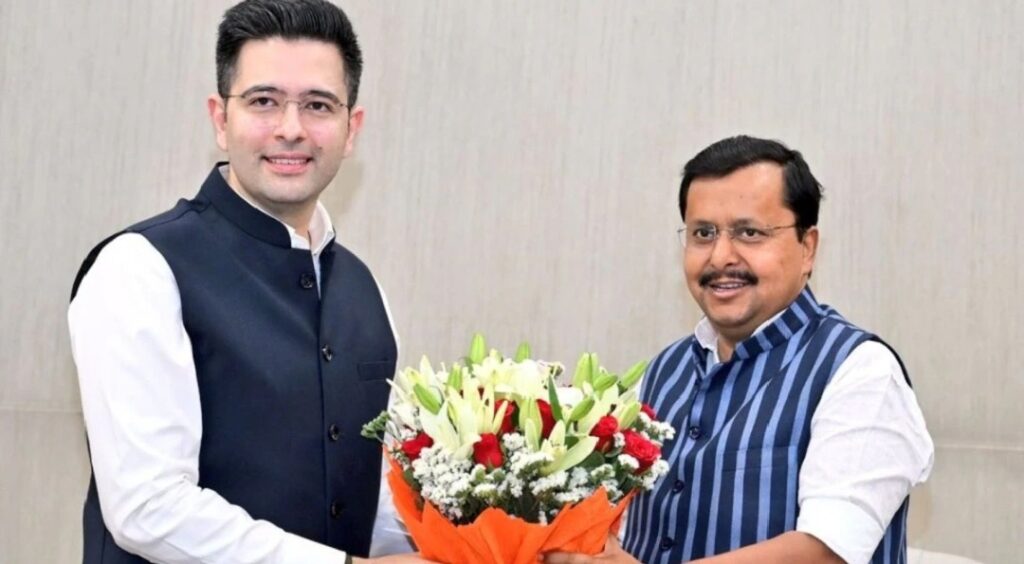
It is not just Raghav Chadha; several prominent leaders, including Sandeep Pathak, have quit the party alongside him. This is not merely the defection of a single leader; rather, it is a clear symptom of the complete collapse of AAP’s ‘National Bench’ (the second tier of national leadership). In this comprehensive article, we will deeply analyze the secrets behind this political shift, the future of AAP, and the master strategy of the Bharatiya Janata Party (BJP).
1. The Rise and Influence of Raghav Chadha in AAP
Raghav Chadha was never just another politician; he was the center of AAP’s youth appeal. A Chartered Accountant (CA) by profession, he came into contact with Arvind Kejriwal during Anna Hazare’s 2011 India Against Corruption movement.
The Architect of the Punjab Elections
Chadha’s political graph skyrocketed during the Punjab Assembly elections. He played a massive role as co-in-charge in bringing a historic victory to the Aam Aadmi Party in the state. His political strategizing, youth-centric speeches, and fierce way of countering the opposition in TV debates molded him into the party’s ultimate ‘Poster Boy’. He made history by entering the Rajya Sabha at the young age of just 33.
2. The Raghav Chadha BJP Move: What Are the Real Reasons for Leaving AAP?
When everything seemed to be going perfectly, what caused this sudden shift? When leaders like Chadha leave a party that built their political careers, there are always grave underlying reasons.
A. Sacrifice of Ideologies and Erosion of Values
The Aam Aadmi Party was an organization built on the foundation of principles and ideals. However, internal discontent had been brewing recently that the party was straying from its core ideologies for the sake of power. When principles are sidelined, it is natural for loyalists to walk out.
B. The Dark Shadow of the Delhi Liquor Scam
The Delhi Liquor Scam has shaken the very roots of the Aam Aadmi Party. With Manish Sisodia, Sanjay Singh, and even Arvind Kejriwal himself facing jail time, the party’s image was completely shattered. Allegations that an anti-corruption party was drowning in corruption caused immense embarrassment to its young leaders. To protect his own “clean image” and political future, stepping out of the party became the only viable option for Raghav Chadha.
C. Dictatorial Leadership and Centralization of Power
According to inside sources within AAP, decisions made by Kejriwal and his inner circle were final and absolute. Second-tier leaders were not given the freedom to operate independently. Outgoing leaders have prominently complained that voices raising questions—such as inquiries regarding the ‘Sheesh Mahal’ (Chief Minister’s residence renovation) controversy—were systematically silenced.
3. BJP’s Strategy: Why Does the Lotus Camp Need Chadha?
The Bharatiya Janata Party is always one step ahead in its political chess game. The Raghav Chadha BJP Move is not a coincidence; it is part of a well-crafted master plan by Amit Shah and J.P. Nadda.
• Attracting the Youth Vote: The BJP lacked young, charismatic faces in Delhi and Punjab. Chadha’s induction is a massive weapon to pull urban youth voters toward the BJP.
• Demoralizing the Opposition: By poaching the Aam Aadmi Party’s most capable spokesperson, the BJP has effectively snatched away AAP’s voice. There is now a severe lack of prominent leaders to fiercely defend AAP in national TV debates.
• Establishing Roots in Punjab: After breaking its alliance with the Akali Dal, the BJP has struggled to find a strong foothold in Punjab. Through Chadha, who intimately understands Punjab’s political landscape, the BJP intends to solidify its base in the state.
4. The Collapse of AAP’s ‘National Bench’
No national party can be run by a single leader. It requires a strong ‘Bench Strength’—meaning, if the first line of leadership is absent, a capable second line must be ready to steer the ship.
In its early days, AAP boasted stalwarts like Prashant Bhushan, Yogendra Yadav, and Kumar Vishwas. After their departure, leaders like Manish Sisodia, Sanjay Singh, Raghav Chadha, Atishi, and Sandeep Pathak filled the void.
But look at the current scenario:
1. Manish Sisodia and Sanjay Singh: Caught in massive legal battles.
2. Raghav Chadha and Sandeep Pathak: Have joined the BJP.
3. Arvind Kejriwal: Facing a severe credibility crisis and corruption charges.
This essentially means AAP’s dream of national expansion is shattered. A party that was restricted to Delhi and Punjab now faces a grim situation where it must struggle just to maintain its existence in those two states alone.
5. Impact on the Upcoming Delhi and Punjab Elections
This political earthquake will completely alter the electoral arithmetic for upcoming Assembly and Lok Sabha elections.
• In Delhi: The middle class formed the backbone of AAP’s voter base. With a continuous exodus of top leaders, there is a very high probability that these voters will swing back toward the BJP.
• In Punjab: Despite having a government led by Bhagwant Mann, the state unit will face massive confusion without central leadership guidance. Sandeep Pathak was the chief architect of Punjab’s internal organization; his exit is a devastating blow to the Punjab AAP cadre.
“The Digital Sage” Analysis
In my view (The Rhythm & Reason Analysis), the crisis facing the Aam Aadmi Party serves as a glaring warning bell for all regional parties in India. This is a clear example of what happens when a political party becomes entirely a ‘Personality Cult’ and forgets its founding ideologies.
Vishal’s Takeaway
Watching this unfold, my straight-up assessment is that politics is ultimately the most cut-throat start-up ecosystem in the world.
When we discussed Anna Hazare’s warning, it was about AAP losing its core values. Chadha’s exit is the final nail in that coffin. The fact that top-tier leaders, including the party’s chief strategist Sandeep Pathak and prominent faces like Swati Maliwal, felt the need to execute a 2/3rd merger shows that the internal machinery of AAP has completely broken down.
For the everyday voter reading The Rhythm & Reason, the big lesson here is about ideological loyalty—or the complete lack of it. In modern Indian politics, ideologies are fluid, and political survival is everything. Raghav Chadha just proved that when the political ship starts sinking, even the loudest critics are more than happy to jump onto the opponent’s lifeboat.
Keep reading ‘The Rhythm & Reason’ for more of such deep and accurate political and financial analyses.
Disclaimer: The political analysis and legislative data provided in this article are for educational and informational purposes only. The Rhythm & Reason does not endorse any political party, ideology, or narrative. This breakdown is based on official parliamentary records and current news reports. Readers are encouraged to consume news critically and verify facts through official democratic channels.
I was recommended to read life of Swami Vivekananda