

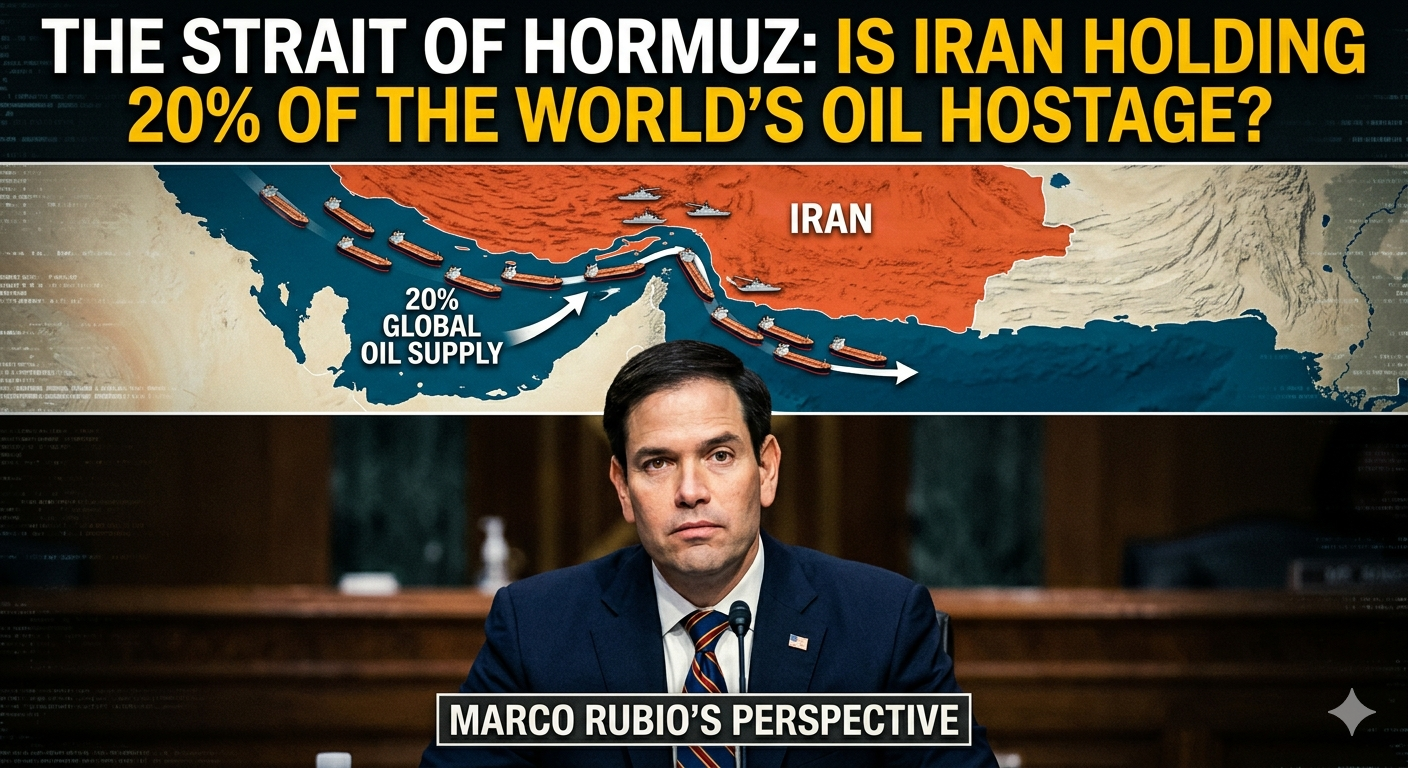
Balancing my daily logistics work on the busy roads of Bengaluru with managing the financial desk here at The Rhythm & Reason, I feel the bite of rising fuel costs firsthand—often before they even show up on the global stock market tickers. Over the past two years of actively tracking global macro-trends, it has become crystal clear that our local economy is inextricably tethered to a narrow strip of water over 2,500 kilometers away: the Strait of Hormuz.
The question echoing from Wall Street to Dalal Street is this: Is Tehran actually preparing to close the Strait of Hormuz, effectively holding one-fifth of the world’s daily oil supply hostage?
Let us know in this
The rhetoric surrounding the standoff between the United States and Iran has reached a new boiling point. In a stark and unyielding assessment of the current geopolitical landscape, U.S. Secretary of State Marco Rubio recently dropped a rhetorical bombshell. Speaking in an interview with Fox News, Rubio characterized Iran’s aggressive posturing and attempts to control the Strait of Hormuz not just as a regional disruption, but as an “economic nuclear weapon” wielded against the world.
As peace proposals are scrapped and global energy markets hold their breath, Rubio’s words highlight a dangerous escalation in the Middle East. With Tehran effectively trying to leverage a massive chunk of the world’s oil supply to force the international community’s hand, the stakes have never been higher.
But what exactly does Rubio mean by this striking phrase? And how does Iran’s grip on a narrow strip of water translate to global economic warfare?
The Chokepoint of the World: Understanding the Strait of Hormuz
To grasp the weight of Rubio’s charge, we first have to understand the geography. The Strait of Hormuz is a narrow waterway connecting the Persian Gulf to the Gulf of Oman and the Arabian Sea.
Despite its small size, it is the most critical oil transit chokepoint on the planet.
- Global Energy Reliance: Approximately 20% to 25% of the world’s total global oil consumption passes through this strait.
- Irreplaceable Route: Unlike other chokepoints, there are very few viable pipeline alternatives to bypass the Strait of Hormuz. If it closes, the energy stays trapped in the Gulf.
When Rubio points out that Iran is “putting up billboards in Tehran bragging about how they can hold 25 percent or 20 percent of the world’s energy hostage,” he is highlighting a terrifying reality. Iran doesn’t need to conquer foreign capitals to inflict pain; it merely needs to drop the gate on the world’s most vital energy highway.
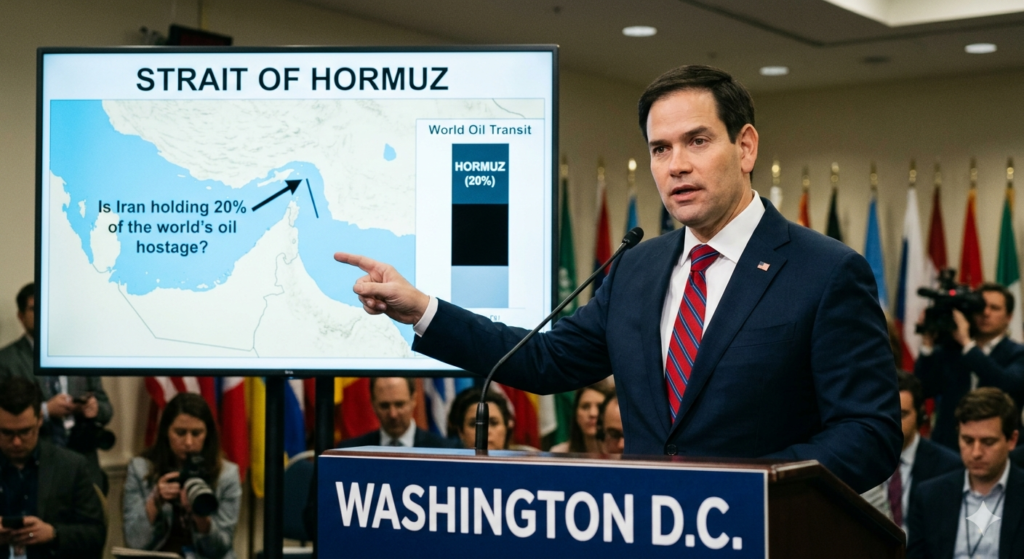
Deconstructing the “Economic Nuclear Weapon”
The phrase “economic nuclear weapon” is a calculated piece of statesmanship. Nuclear weapons are the ultimate deterrent because their use promises catastrophic, widespread, and indiscriminate destruction. By comparing Iran’s maritime strategy to a nuclear device, Rubio is making a profound point about the scale of the threat.
The Power to Cripple Economies
If Iran were to fully blockade the strait or impose exorbitant “tolls” for safe passage, the immediate result would be a massive supply shock. Global oil prices would skyrocket, plunging economies into recession, driving up inflation, and severely impacting the daily lives of billions of people. It is an act of economic devastation on a scale comparable to the physical devastation of a nuclear strike.
The Illusion of “Opening” the Strait
Recent reports indicate that Iran offered a peace proposal, mediated by Pakistan, which included an offer to “reopen” the Strait of Hormuz on three conditions—a proposal President Donald Trump swiftly rejected. Rubio dismantled this offer, exposing the semantic games at play.
”If opening the strait means you need Iran’s permission or have to pay to pass, that’s not opening it,” Rubio stated clearly. “We cannot allow a system where Iran decides who can use an international waterway or at what cost.”
Rubio is pointing out that a conditional opening is simply extortion by another name. Transforming international waters into a sovereign toll road sets a dangerous global precedent. If Iran is permitted to charge a “tax” on global energy under the threat of violence, it hands a radical regime an inexhaustible source of revenue and leverage.
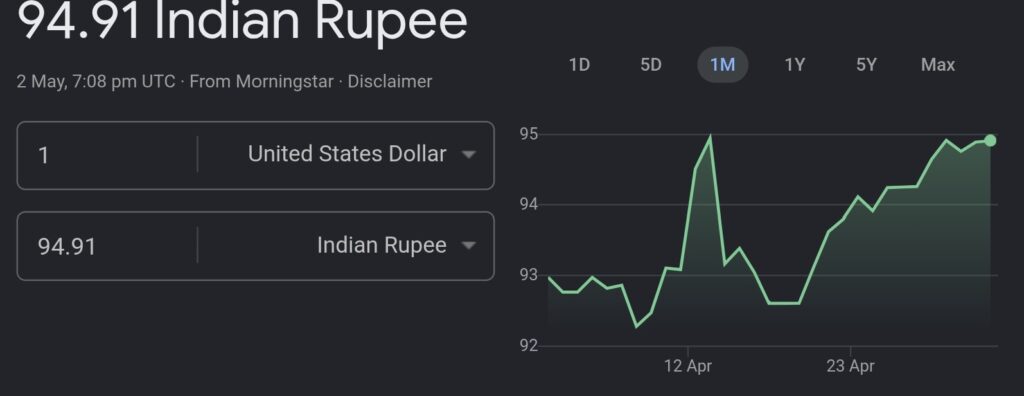
In this image Rupee Freefall: As we have seen with the Rupee dipping past 95 against the dollar, higher oil prices demand more dollar outflows, weakening the domestic currency.
The Strategy of Desperation
Why is Iran taking such a massive gamble? According to the U.S. State Department, it boils down to internal desperation rather than sheer strength.
A Fractured Leadership
Rubio noted that the Iranian leadership is “deeply fractured” and dealing with immense internal turmoil. Years of extraordinary sanctions have crippled the Iranian economy, leading to widespread public dissatisfaction. The regime is desperately looking for a diplomatic off-ramp to get out of the “mess they’re in.”
Buying Time
By offering temporary truces and conditional reopening of waterways, Tehran is likely trying to buy time and secure sanctions relief. Their proposal notably pushes negotiations regarding their nuclear program to a later date—allowing them to escape immediate pressure without abandoning their ultimate strategic goals.
The Looming Nuclear Shadow
Perhaps the most chilling aspect of Rubio’s warning is the direct link he drew between Iran’s current actions with oil and its future ambitions with uranium.
”Again, they want to do with the world with a nuclear weapon what they are doing now with oil,” Rubio warned. “They want to hold the world hostage so they can do whatever they want. That’s unacceptable.”
This is the crux of the Trump administration’s hardline stance. The administration recognizes that if Iran is willing to ruthlessly leverage the global economy to extract concessions now, arming them with an actual nuclear arsenal would be catastrophic. President Trump has consistently insisted that a deal must permanently address the nuclear threat, not just kick the can down the road in exchange for a temporary easing of maritime extortion.
The Global Response: Action Over Words
Rubio didn’t just target Iran; he also directed a sharp critique at the broader international community. He challenged global leaders who frequently invoke the “international community” but hesitate to act when global stability is threatened.
What is happening in the Strait of Hormuz is not just a localized conflict or a U.S.-Iran bilateral dispute. It is a direct threat to global peace and global stability. The U.S. is currently enforcing a naval blockade targeting Iran-linked vessels, but the administration is urging allies to recognize that securing international waterways is a shared, global responsibility.
you can also references Marco Rubio’s stark warning on Iran’s economic tactics
This clip provides breaking news coverage and analysis of Secretary of State Marco Rubio’s exact statement regarding Iran wielding the Strait of Hormuz as an “economic nuclear weapon.”
While the international community wrestles with state-level extortion and geopolitical standoffs in the Middle East, the fight for transparent, accountable leadership remains a global theme—whether it is demanding clear nuclear agreements abroad, or fighting systemic corruption domestically,
Vishal’s Takeaway
Tracking these geopolitical games for the past two years, my straight-up assessment is that while the news sounds scary, an actual, long-term closure of the Strait of Hormuz is highly unlikely.
Why? Because closing the strait is basically economic suicide. Sure, it would crash the global markets, but it would also totally cut off Iran’s last income lifeline from its few remaining buyers, like the independent refiners in Asia. On top of that, blocking international waters is a direct invitation for a massive military strike from global superpowers whose economies run on that oil.
For retail investors and our regular readers at The Rhythm & Reason, the game plan remains the same: please don’t panic-sell your portfolio just because of this geopolitical bluffing. Having said that, we have to accept that this heavy volatility is the new normal. Keep a close eye on energy stocks to hedge your bets, keep some cash handy to buy the dips, and remember—in the global oil game, creating panic is often a much bigger weapon than an actual blockade.
Disclaimer: The market data, geopolitical analysis, and financial perspectives provided in this article are for informational and educational purposes only. The Rhythm & Reason does not provide certified financial, investment, or trading advice. Global commodities and equity markets are highly volatile. Always conduct your own research or consult with a registered financial advisor before making any investment decisions.
recommend for read in my website about biography about Anna Hazare