

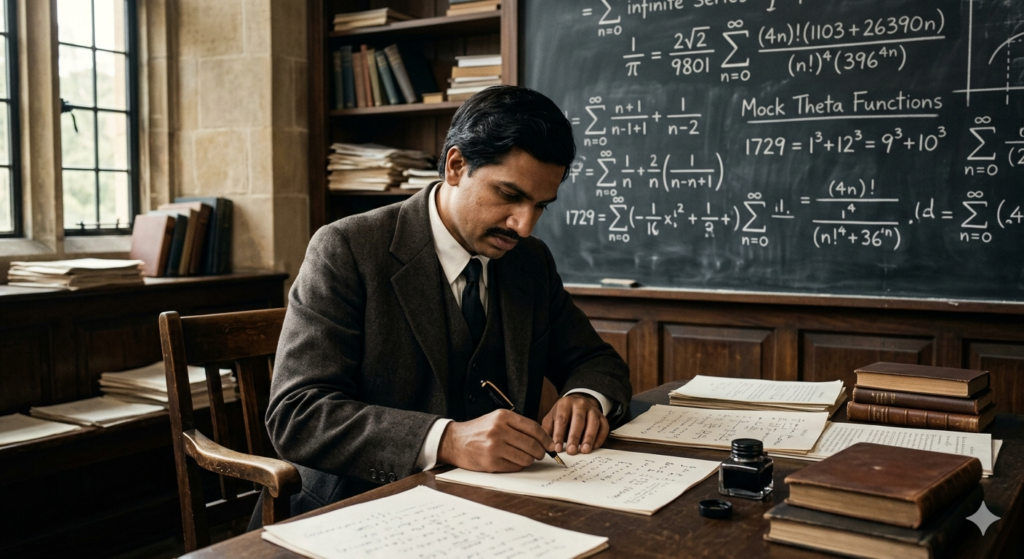
Srinivasa Ramanujan was an Indian mathematician who, with almost no formal training, made extraordinary contributions to mathematical analysis, number theory, infinite series, and continued fractions. His life is a testament to the power of raw genius and perseverance.
Early Life: A Slate and a Dream
Born on December 22, 1887, in Erode, Tamil Nadu, Ramanujan’s brilliance was evident early on. By age 13, he had mastered advanced trigonometry. While other children were playing, Ramanujan was often found sitting on his porch, furiously scribbling complex formulas on a stone slate. Because paper was expensive, he used his elbow to erase the slate, which often left his arm blackened by the end of the day.
The “Rhythm” of Numbers Ramanujan claimed that his discoveries were not the result of mere calculation, but were placed on his tongue by the goddess Namagiri Thayar. He saw a spiritual rhythm in numbers, once saying:”An equation for me has no meaning, unless it represents a thought of God.”
The Journey to Cambridge
Despite his genius, Ramanujan struggled in college because he neglected all subjects except mathematics. Living in poverty and working as a clerk at the Madras Port Trust, he began sending his work to famous mathematicians in England.
Most ignored him, but G.H. Hardy at Cambridge University recognized the spark of a “legend.” Hardy famously remarked that Ramanujan’s formulas “must be true because, if they were not, no one would have the imagination to invent them.” In 1914, Ramanujan made the long journey to England, leaving his home to prove his theories to the world.
Major Contributions
The Hardy-Ramanujan Number (1729): Known as the “Taxi-cab number,” it is the smallest number expressible as the sum of two cubes in two different ways (1729 = 1^3 + 12^3 = 9^3 + 10^3).
Infinite Series for Pi (\pi): He developed incredibly fast ways to calculate the value of \pi, which are still used by modern computers today.
Mock Theta Functions: These were found in his “Lost Notebook” and are now being used to understand the physics of black holes.
Legacy
Ramanujan’s health suffered in the cold English climate. He returned to India and passed away at the young age of 32 in 1920. However, he left behind thousands of original theorems that took mathematicians nearly 100 years to fully prove. Every year, India celebrates December 22 as National Mathematics Day in his honor.
Why Ramanujan Matters Today: His work on “Mock Theta Functions” is currently helping scientists understand the behavior of Black Holes, proving that his “reasoning” was decades ahead of its time.
note: Srinivasa Ramanujan’s — crypto Or digital gold(he was unknowingly laying the groundwork for the technology that secures your Bitcoin wallet today)
[…] event highlights the psychological factors we explore in our biography of Srinivasa Ramanujan, where logic meets […]