

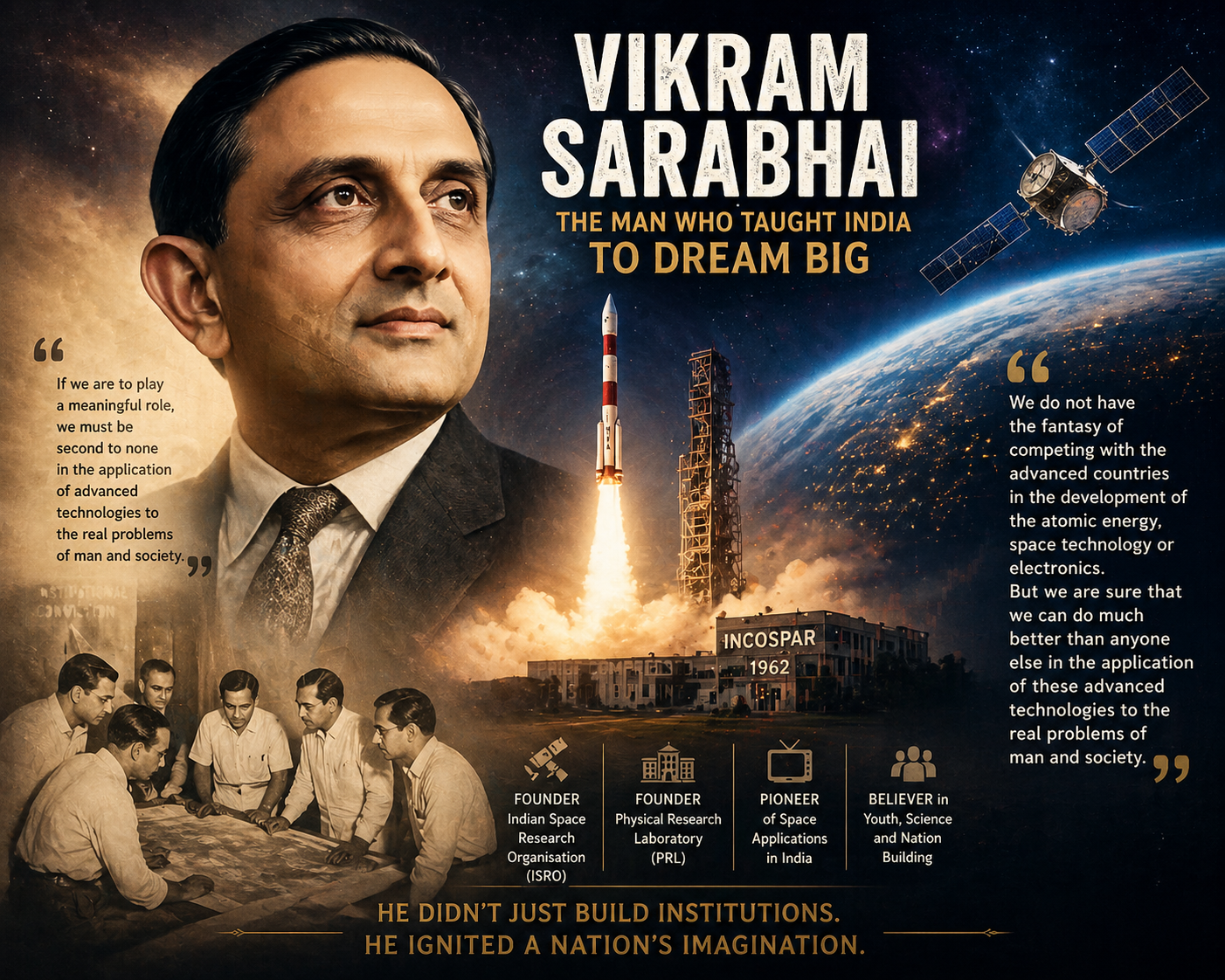
Today, the Indian Space Research Organisation (ISRO) stands tall as one of the premier space agencies in the world. Behind the monumental success of historic missions like Chandrayaan, Mangalyaan, and Aditya-L1 lies the vision of one extraordinary mind: Dr. Vikram Sarabhai.
From transporting rocket parts on bicycles and bullock carts to launching over a hundred satellites in a single mission, India’s journey into space is a testament to Sarabhai’s foresight and relentless hard work. In this comprehensive Vikram Sarabhai biography, we will delve into the inspiring life, education, and unparalleled contributions of the man universally revered as the “Father of the Indian Space Program.”
1. Childhood and Family Background
Dr. Vikram Sarabhai
was born on August 12, 1919, in Ahmedabad, Gujarat. He hailed from a highly affluent and influential family of industrialists. His parents, Ambalal and Saraladevi Sarabhai, had eight children, of which Vikram was one.
The Sarabhai family was actively involved in the Indian independence movement. Their home was frequently visited by stalwarts like Mahatma Gandhi, Rabindranath Tagore, and Jawaharlal Nehru. Growing up in such an intellectually stimulating and nationalistic environment, Vikram developed a profound interest in science, art, and national service from a very young age.
2. Education and Training Under a Nobel Laureate
Vikram Sarabhai completed his primary education in Ahmedabad. With a deep passion for science and mathematics, he traveled to England and enrolled at the prestigious Cambridge University, earning his degree in Natural Sciences in 1940.
Due to the outbreak of the Second World War, he had to return to India. Upon his return, he joined the renowned Indian Institute of Science (IISc) in Bangalore. Here, he had the golden opportunity to conduct research under the guidance of Nobel Laureate Sir C.V. Raman. He deeply researched Cosmic Rays and, after the war ended, returned to Cambridge. In 1947, he was awarded a Ph.D. for his thesis titled “Cosmic Ray Investigations in Tropical Latitudes.”
3. The Institution Builder
Vikram Sarabhai was not just a brilliant scientist; he was a visionary administrator and a master institution builder. In a newly independent India, he recognized the urgent need to establish a strong scientific foundation.
At the young age of 28, on November 11, 1947, he founded the Physical Research Laboratory (PRL) in Ahmedabad. This was his dream project and the cradle of India’s space sciences.
Other major institutions he established or played a pivotal role in founding include:
• Indian Institute of Management, Ahmedabad (IIM-A): Today, it is recognized as India’s premier management institute.
• Darpana Academy of Performing Arts: Founded alongside his wife, the legendary classical dancer Mrinalini Sarabhai, to promote art and culture.
• Nehru Foundation for Development (NFD).
• Ahmedabad Textile Industry’s Research Association (ATIRA).
4. The Birth of the Indian Space Program (ISRO)
When the Soviet Union launched the ‘Sputnik’ satellite in 1957, the whole world turned its eyes to space. At that time, India was grappling with severe issues of poverty and food security. Many critics questioned, “Does a poor country like India need a space program?”
But Vikram Sarabhai’s vision was crystal clear. He famously stated:
“We do not have the fantasy of competing with the economically advanced nations in the exploration of the moon or the planets or manned space-flight. But we are convinced that if we are to play a meaningful role nationally, and in the community of nations, we must be second to none in the application of advanced technologies to the real problems of man and society.”
His unwavering conviction successfully convinced the Indian government. In 1962, under his leadership, the Indian National Committee for Space Research (INCOSPAR) was established, which later evolved into the Indian Space Research Organisation (ISRO) in 1969.
Rocket Launch at Thumba:
A small fishing village named Thumba near Thiruvananthapuram, Kerala, was selected as the rocket launching station (TERLS). Using a local church as an office and transporting parts on bicycles and bullock carts, India successfully launched its first sounding rocket (Nike-Apache) on November 21, 1963. This marked the dawn of India’s space age.
5. Nuclear Energy and Mentoring APJ Abdul Kalam
Following the tragic death of Dr. Homi J. Bhabha (the father of India’s nuclear program) in a plane crash in 1966, Vikram Sarabhai took over the immense responsibility as the Chairman of the Atomic Energy Commission.
Another of his greatest achievements was identifying and nurturing young talent. It was Sarabhai who spotted the spark in a young scientist named A.P.J. Abdul Kalam and sent him to NASA for training in rocket technology. In his autobiography, Dr. Kalam affectionately and reverently remembers Sarabhai as his ultimate “mentor and guru.”
6. Revolution in Telecommunication and Education (SITE Experiment)
Sarabhai dreamed of using satellite technology not just for high-end science, but to bring education to the remotest corners of the country. To achieve this, he collaborated with NASA to design an incredible project called SITE (Satellite Instructional Television Experiment).
Through this initiative, educational programs on agriculture, health, and primary education were broadcast via satellite to over 2,400 backward villages in India. Unfortunately, Sarabhai did not live to see the project implemented in 1975.
7. Death and Lasting Legacy
On December 30, 1971, Dr. Vikram Sarabhai passed away unexpectedly due to a heart attack in Kovalam, Kerala, at the age of just 52. His death was an irreplaceable loss to the Indian scientific community.
After his passing, India launched its first satellite, “Aryabhata,” in 1975. Today, ISRO stands on the solid foundation he built. In his honor, the lander used in the historic Chandrayaan-2 and Chandrayaan-3 missions was named the “Vikram Lander.”
Conclusion
This Vikram Sarabhai biography serves as a profound inspiration for every Indian. In a brief lifespan of 52 years, his achievements for the nation were monumental. From carrying rockets on bicycles to becoming a nation that reached Mars on its first attempt, it was all made possible because Sarabhai dared to dream big.
His life teaches us a powerful lesson: no matter the obstacles, never stop dreaming big and working towards the betterment of society.
Recommended Reading
To read more about legendary figures who played a crucial role in building the nation, check out these articles on our site:
• [Swami Vivekananda Biography and His Message to the Youth]