

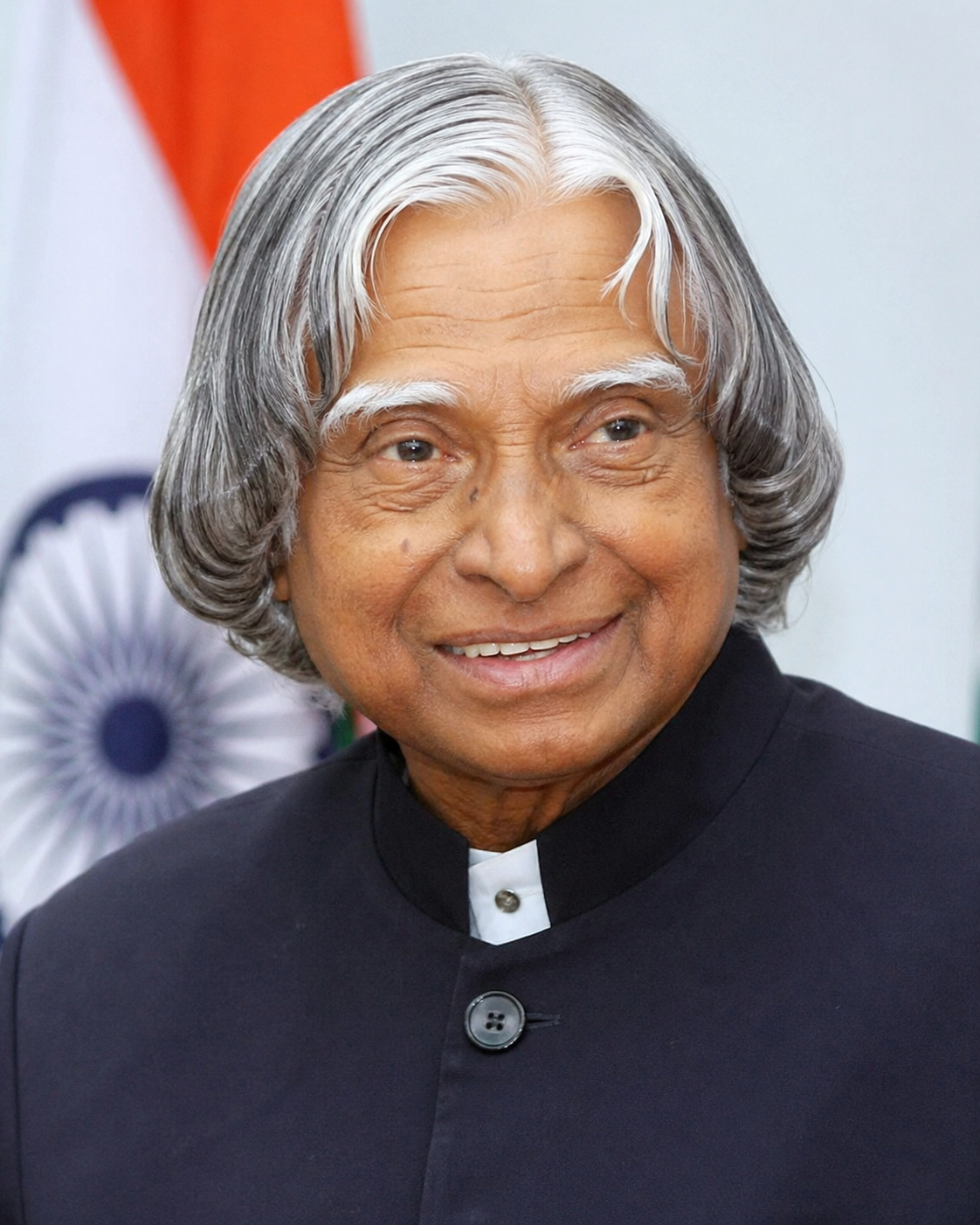
There are very few leaders in modern history who have commanded the universal love, respect, and admiration of an entire nation quite like Dr. Avul Pakir Jainulabdeen Abdul Kalam. He was a scientist who touched the stars, a president who touched the masses, and a teacher who ignited millions of young minds.
From distributing newspapers on the quiet streets of Rameswaram to occupying the highest constitutional office in the Rashtrapati Bhavan, his life is the ultimate testament to the power of hard work, humility, and education. In this comprehensive APJ Abdul Kalam biography, we will journey through the life of India’s “Missile Man” and explore how his legacy continues to shape the future of a billion people.
1. Early Life: The Boy from Rameswaram
Dr. A.P.J. Abdul Kalam was born on October 15, 1931, in the pilgrimage town of Rameswaram on Pamban Island, Tamil Nadu. He came from a humble Tamil Muslim family. His father, Jainulabdeen, was a boat owner and an imam at a local mosque, while his mother, Ashiamma, was a housewife.
The family had once been wealthy traders, but by the time Kalam was born, their fortunes had dwindled, and they lived in modest conditions. Despite financial hardships, his parents provided a home filled with love, spiritual wisdom, and deep secular values. Kalam often recalled how his father and the high priest of the Rameswaram temple, Pakshi Lakshmana Sastry, would sit together and discuss spiritual matters. This early exposure to religious harmony deeply influenced Kalam’s secular worldview.
The Newspaper Boy
To support his family’s income, a young Abdul Kalam took up the job of a newspaper boy. He would wake up before dawn, collect newspapers dropped from the passing trains, and distribute them across the town before heading to school. This early life of rigor instilled in him an unmatched work ethic and an understanding of the value of hard-earned money.
2. Education: The Spark of Aviation
Kalam was an average student in his school days but possessed an insatiable curiosity and a strong desire to learn, particularly in mathematics. After completing his schooling at Schwartz Higher Secondary School in Ramanathapuram, he went on to attend St. Joseph’s College in Tiruchirappalli, graduating in Physics in 1954.
However, his true passion lay in the skies. He wanted to fly. Moving closer to his dream, he moved to Madras (now Chennai) in 1955 to study aerospace engineering at the prestigious Madras Institute of Technology (MIT).
The Deadline That Shaped Him
At MIT, Kalam faced a defining moment. He was working on a senior class project designing a low-level attack aircraft. The Dean of the institute was highly dissatisfied with the progress and threatened to revoke Kalam’s scholarship if the project was not completed within three days. For a student from a poor background, losing a scholarship meant the end of his education.
Working day and night, entirely foregoing sleep, Kalam completed the project before the deadline. The Dean, deeply impressed, hugged him and said, “I was putting you under stress and asking you to meet a difficult deadline.” This experience taught Kalam how to thrive under immense pressure, a skill that would serve him well in India’s space and defense programs.
3. The Making of the “Missile Man” (DRDO & ISRO)
Kalam narrowly missed achieving his dream of becoming a fighter pilot in the Indian Air Force, as he secured the ninth position and there were only eight slots available. Disappointed but not defeated, he joined the Defense Research and Development Organization (DRDO) as a scientist in 1958.
The ISRO Years and Vikram Sarabhai
In 1969, Kalam was transferred to the Indian Space Research Organisation (ISRO). This was a pivotal moment in the APJ Abdul Kalam biography. Here, he worked directly under the visionary Dr. Vikram Sarabhai, the father of the Indian space program.
Under Sarabhai’s mentorship, Kalam became the Project Director of India’s first indigenous Satellite Launch Vehicle (SLV-III). After years of tireless effort and a heartbreaking initial failure in 1979, Kalam and his team successfully deployed the Rohini satellite into near-earth orbit in July 1980. This monumental achievement made India a member of the exclusive space club.
The Integrated Guided Missile Development Program (IGMDP)
In the 1980s, Kalam returned to DRDO to lead the Integrated Guided Missile Development Program (IGMDP). He was tasked with developing a fleet of indigenous missiles to secure India’s borders. Under his brilliant leadership, India successfully developed strategic missiles, most notably:
• Agni: An intermediate-range ballistic missile.
• Prithvi: A tactical surface-to-surface missile.
The resounding success of these projects earned him the enduring title of the “Missile Man of India.”
Pokhran-II Nuclear Tests
In May 1998, Kalam played a crucial technological and political role in the Pokhran-II nuclear tests alongside Dr. R. Chidambaram. Serving as the Chief Project Coordinator, his leadership ensured the tests were a success, officially declaring India as a nuclear-armed state and shifting the global geopolitical landscape.
4. The 11th President of India (2002–2007) APJ Abdul Kalam
In 2002, the ruling National Democratic Alliance (NDA), backed by the opposition Indian National Congress, nominated Dr. A.P.J. Abdul Kalam for the Presidency of India. He won the election by a massive margin, becoming the 11th President of the Republic of India.
The People’s President
Kalam redefined the presidency. He was the first scientist and the first bachelor to occupy the Rashtrapati Bhavan. He opened the doors of the presidential palace to the public, especially children. He refused to be bound by the rigid protocols of the office, often breaking security cordons to interact directly with students and common citizens.
His presidency was marked by a deep focus on:
• Vision 2020: A comprehensive blueprint to transform India into a developed nation by the year 2020, focusing on rural development, education, and technology.
• PURA (Providing Urban Amenities to Rural Areas): A strategy to bridge the rural-urban divide by bringing modern infrastructure and connectivity to villages.
When his term ended in 2007, there was a widespread public demand for him to serve a second term, but he gracefully chose to step down and return to his first love: teaching.
5. Life After the Presidency: A Teacher Until the End
Dr. Kalam often said that he wanted to be remembered, first and foremost, as a teacher. After leaving the presidency, he became a visiting professor at several prestigious institutions, including the Indian Institutes of Management (IIM) in Shillong, Ahmedabad, and Indore.
He traveled relentlessly across the country and the world, addressing millions of students. He urged the youth to dream big, famously stating:
“Dream, dream, dream. Dreams transform into thoughts and thoughts result in action.”
He believed that the youth were the greatest asset of the nation. His interactions with students were never one-sided lectures; they were dialogues where he encouraged them to ask difficult questions and think critically.
6. The Final Moments: Doing What He Loved
On July 27, 2015, Dr. Kalam traveled to Shillong to deliver a lecture on “Creating a Livable Planet Earth” at IIM Shillong. While speaking to the students—doing exactly what he loved most—he suffered a massive cardiac arrest and collapsed on stage. He was rushed to the hospital but was pronounced dead shortly after. He was 83 years old.
His sudden death plunged the nation into deep mourning. The Government of India declared a seven-day state mourning. He was laid to rest in his hometown of Rameswaram with full state honors, attended by hundreds of thousands of people from all walks of life.
7. Books, Literary Legacy, and Philosophy
Dr. Kalam was a prolific writer whose books have sold millions of copies worldwide, inspiring generations of readers. His most notable works include:
• Wings of Fire (1999): His globally acclaimed autobiography that details his early life, struggles, and the development of India’s space and missile programs.
• Ignited Minds (2002): A book dedicated to the youth of India, urging them to realize their potential.
• India 2020 (1998): A roadmap for India’s future economic and technological development.
His philosophy was deeply rooted in the belief that science and spirituality are not opposing forces but two sides of the same coin. He read the Quran and the Bhagavad Gita with equal reverence and frequently played the Veena, a traditional Indian musical instrument.
8. Awards and Honors
A life dedicated to the nation did not go unrecognized. Dr. Kalam was the recipient of numerous awards, including honorary doctorates from over 40 universities across the globe. The Government of India honored him with the highest civilian awards:
• Padma Bhushan (1981)
• Padma Vibhushan (1990)
• Bharat Ratna (1997) – The highest civilian honor of India, awarded for his immense contribution to the scientific research and modernization of defense technology.
Conclusion
The APJ Abdul Kalam biography is not merely a historical account of a scientist or a politician; it is a guidebook on how to live a life of purpose, humility, and dedication. He showed the world that it does not matter where you come from—whether you are a newspaper boy in a small village or the son of a boatman—what matters is where you want to go.
Dr. Kalam left behind no financial wealth, no property, and no biological children. Yet, he left behind a nation of 1.4 billion people who continue to call him their own. His legacy lives on in every rocket that ISRO launches, in every missile that guards the borders, and most importantly, in the ignited minds of the Indian youth.
Frequently Asked Questions (FAQs) by people
Q1: Why is Dr. APJ Abdul Kalam called the “Missile Man of India”?
A: He is called the Missile Man because of his crucial role in developing India’s indigenous ballistic missiles, namely Agni and Prithvi, under the Integrated Guided Missile Development Program (IGMDP).
Q2: What is the name of APJ Abdul Kalam’s autobiography?
A: His famous autobiography is titled “Wings of Fire”, published in 1999, which chronicles his journey from a humble background to a leading space scientist.
Q3: When did APJ Abdul Kalam serve as the President of India?
A: He served as the 11th President of India from 2002 to 2007.
Q4: Did APJ Abdul Kalam have a family?
A: Dr. Kalam remained a bachelor his entire life and did not have a wife or children. However, he always considered the youth of India as his extended family.
Q5: What was APJ Abdul Kalam’s Vision 2020?
A: Vision 2020 was his comprehensive plan to transform India from a developing nation into a fully developed, economically prosperous, and technologically advanced powerhouse by the year 2020.
Explore More Inspiring Biographies on The Rhythm & Reason:
Life and Legacy of Swami Vivekananda: Monk Who Shook the World