
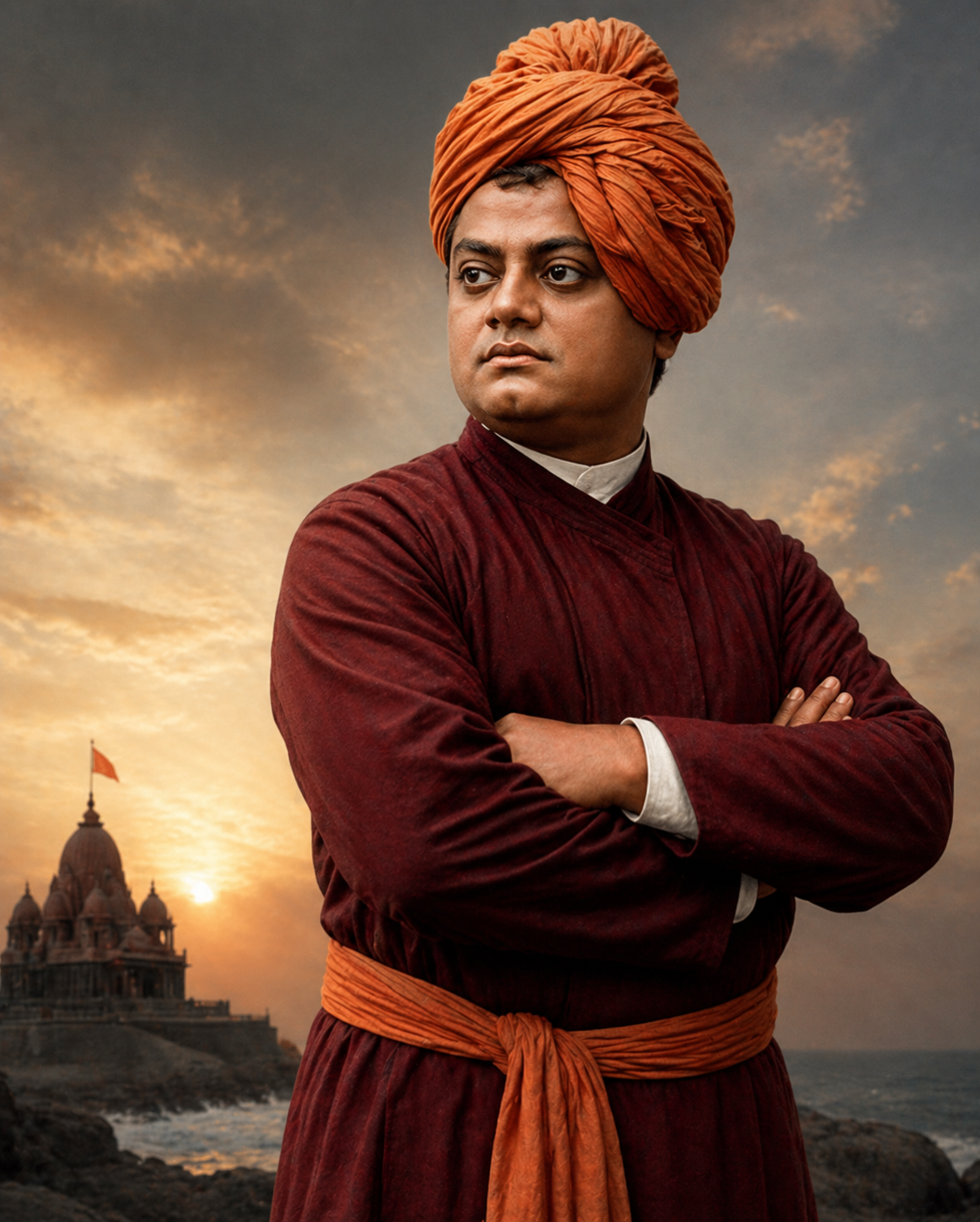
History is shaped by individuals who dare to challenge the status quo, uplift the masses, and bridge the gap between different cultures and philosophies. Among such towering figures stands Swami Vivekananda, a spiritual giant, a fierce patriot, and a profound philosopher. His life was a brief but blazing meteor that illuminated the skies of human consciousness.
From a curious and rational young boy in Kolkata to the monk who introduced the profound concepts of Vedanta and Yoga to the Western world, the Swami Vivekananda biography is a masterclass in self-realization and service to humanity. In this comprehensive article, we will explore his early life, his spiritual awakening, his historic speech in Chicago, and the enduring legacy he left behind for the modern world.
1. Early Life and Childhood: The Making of Narendranath
Swami Vivekananda was born as Narendranath Datta on January 12, 1863, in Kolkata (then Calcutta), during the Makar Sankranti festival. He belonged to a traditional, affluent Bengali family. His father, Vishwanath Datta, was a successful attorney at the Calcutta High Court, known for his progressive and liberal mindset. His mother, Bhuvaneshwari Devi, was a deeply religious woman who instilled in him the values of spirituality and compassion.
From a young age, Narendranath (affectionately called Naren) exhibited traits that set him apart. He was exceptionally intelligent, restless, and possessed a memory that bordered on photographic. He excelled in music, gymnastics, and studies. However, the most defining characteristic of young Naren was his rational and questioning mind. He refused to accept anything on blind faith, a trait that would later define his philosophical approach.
The Quest for Truth
As Naren grew older and entered college, his mind became a battleground of ideas. He devoured the works of Western philosophers like Herbert Spencer, Immanuel Kant, and John Stuart Mill. This exposure to Western logic and scientific thinking made him highly skeptical of traditional religious dogmas. He joined the Brahmo Samaj, a reformist movement that believed in a formless God and sought to strip Hinduism of its superstitions.
Yet, the Brahmo Samaj could not quench his deep spiritual thirst. He was haunted by a single, burning question: “Have you seen God?” He asked this question to numerous prominent religious leaders and scholars of his time, but none could give him a satisfactory answer.
2. The Turning Point: Meeting Sri Ramakrishna Paramahamsa
Narendranath’s relentless pursuit of truth eventually led him to the Dakshineswar Kali Temple in 1881, where he met Sri Ramakrishna Paramahamsa. This meeting was the turning point in the Swami Vivekananda biography.
When Naren asked Ramakrishna his trademark question, “Sir, have you seen God?”, the mystic’s reply was immediate and profound: “Yes, I have seen God. I see Him as I see you here, only much more clearly. God can be seen. One can talk to him. But who cares for God? People shed torrents of tears for their wives, children, wealth, and property, but who weeps for the vision of God?”
This unhesitating, experiential assertion shocked Naren. Initially, his rational mind rebelled against Ramakrishna’s ecstatic states and devotion to the Goddess Kali. Naren tested Ramakrishna repeatedly, arguing and debating with him. However, the pure, unconditional love and the immense spiritual power of Ramakrishna slowly melted Naren’s resistance. Under Ramakrishna’s guidance, Naren transformed from a skeptical intellectual into a realized soul, eventually accepting him as his Guru.
3. The Wandering Monk of India
After the passing of Sri Ramakrishna in 1886, Narendranath and a small group of fellow disciples took monastic vows, officially becoming monks. It was during this time that he assumed the name “Swami Vivekananda” (the bliss of discerning wisdom).
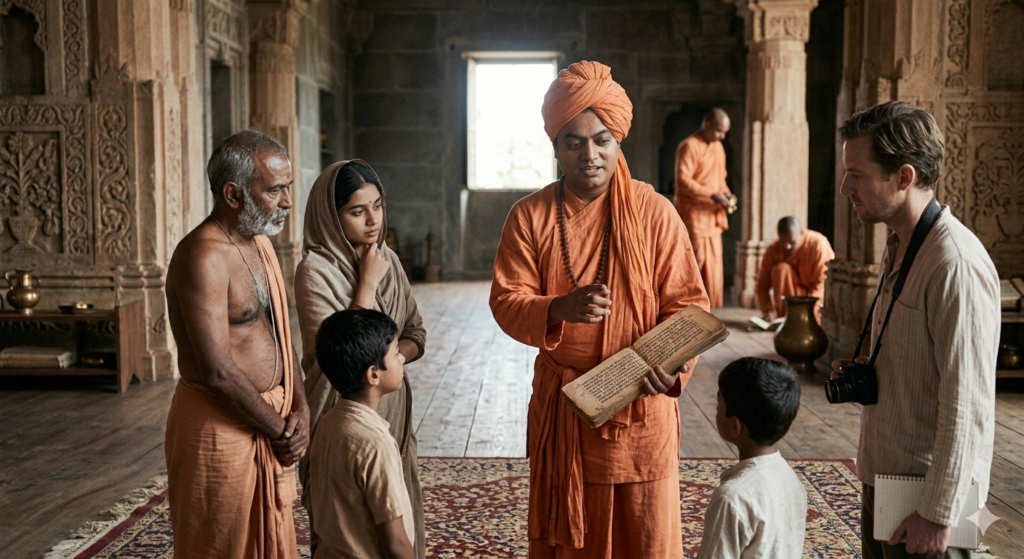
In 1890, Vivekananda set out on a journey across India as a wandering monk (Parivrajaka). For years, he traveled the length and breadth of the country, from the Himalayas to Kanyakumari. He interacted with people from all walks of life—kings and beggars, scholars and the illiterate, the rich and the downtrodden.
Witnessing the Pain of the Masses
This journey deeply moved him. He witnessed the appalling poverty, caste-based discrimination, and the general degradation of the Indian masses under British colonial rule. He realized that religion could not be preached to empty stomachs. His famous realization was: “It is an insult to a starving people to offer them religion; it is an insult to a starving man to teach him metaphysics.”
It was at Kanyakumari, sitting on the last rock of the Indian peninsula (now known as the Vivekananda Rock Memorial), that he had a profound vision. He resolved to dedicate his life to the upliftment of the Indian masses and decided to travel to the West to seek financial help for his motherland, in exchange for the spiritual treasures of India.
4. The Parliament of the World’s Religions: Chicago, 1893
The most iconic moment in the life and legacy of Swami Vivekananda occurred in September 1893. With the help of his disciples and well-wishers (notably the Maharaja of Khetri), Vivekananda traveled to the United States to represent Hinduism at the Parliament of the World’s Religions in Chicago.
Facing a massive audience of over 7,000 delegates and religious leaders from around the world, the relatively unknown monk took the stage on September 11, 1893. He began his speech not with formal, sectarian greetings, but with the heartfelt words:
Sisters and Brothers of America
The audience was instantly captivated by the sincerity and universal love in his voice, responding with a standing ovation that lasted for several minutes. In his brief but electrifying speech, he introduced Hinduism as the “mother of religions,” a faith that taught not just tolerance, but universal acceptance.
He famously stated: “We believe not only in universal toleration but we accept all religions as true. I am proud to belong to a nation which has sheltered the persecuted and the refugees of all religions and all nations of the earth.”
Impact on the West
Following his success in Chicago, Vivekananda spent nearly four years lecturing across the United States and Europe. He established the Vedanta Society in New York and London, bridging the intellectual divide between the East and the West. He introduced the concepts of Yoga and Vedanta to a Western audience that was rapidly industrializing and craving spiritual substance.
5. The Founding of the Ramakrishna Mission
Having established a global platform for Indian philosophy, Vivekananda returned to India in 1897 to a hero’s welcome. However, he did not rest on his laurels. His primary focus remained the upliftment of the poor and the revitalization of the Indian spirit.
On May 1, 1897, he founded the Ramakrishna Mission in Calcutta. The mission’s motto was: “Atmano mokshartham jagat hitaya cha” (For one’s own salvation and for the welfare of the world).
This was a revolutionary step in the context of traditional Indian monasticism. Instead of monks isolating themselves in forests to seek personal enlightenment, Vivekananda mandated that his monks must serve humanity. The Ramakrishna Mission became a pioneering organization in India for humanitarian relief, running hospitals, schools, and undertaking massive disaster relief operations.
6. Core Teachings and Philosophy
The teachings of Swami Vivekananda are vast, synthesizing the ancient wisdom of the Upanishads with the practical needs of the modern world. His philosophy, often termed “Practical Vedanta,” revolves around a few core tenets:
A. The Divinity of the Soul
Vivekananda taught that every human being is inherently divine. The goal of life is to manifest this inner divinity through work, worship, or psychic control. He famously said, “All power is within you; you can do anything and everything. Believe in that, do not believe that you are weak.”
B. The Four Yogas
He systematically categorized the paths to spiritual realization into four Yogas, making them accessible to different personality types:
1. Karma Yoga: The path of selfless action and duty.
2. Bhakti Yoga: The path of love and devotion.
3. Jnana Yoga: The path of knowledge and intellectual inquiry.
4. Raja Yoga: The path of meditation and psychic control.
C. Empowerment of the Youth
Vivekananda had immense faith in the power of the youth. He believed that strong, energetic, and fearless young people were the key to national regeneration. His call to the youth was simple yet thunderous: “Arise, awake, and stop not till the goal is reached.” He emphasized physical strength as much as spiritual strength, once remarking that one could understand the Bhagavad Gita better with strong biceps.
D. Universal Religion
He rejected sectarianism and religious fanaticism. He believed that all religions are different paths leading to the same ultimate truth, much like different rivers flowing into the same ocean.
7. The Final Years and Mahasamadhi
The relentless travel, rigorous schedule of lectures, and his absolute dedication to his work took a heavy toll on Swami Vivekananda’s physical health. He suffered from asthma, diabetes, and other ailments. Despite his failing health, he continued to guide the Ramakrishna Math and Mission, write extensively, and inspire his disciples.
On July 4, 1902, at the Belur Math (the headquarters of the Ramakrishna Mission), Vivekananda spent the day meditating, teaching his disciples, and walking on the banks of the Ganges. In the evening, he retired to his room and entered a deep meditative state. At the age of 39, he attained Mahasamadhi, fulfilling his own prophecy that he would not live to see the age of forty.
8. Global Impact and Enduring Legacy
The legacy of Swami Vivekananda is unquantifiable. He is widely regarded as one of the primary architects of modern India. His patriotic speeches inspired a whole generation of freedom fighters, including Netaji Subhas Chandra Bose, Sri Aurobindo, and Mahatma Gandhi. Gandhi once noted that reading Vivekananda’s works had increased his love for his country a thousandfold.
Globally, Vivekananda is recognized as the first spiritual ambassador of India to the West. He broke down the stereotypes of India as a land of snake charmers and presented it as a civilization with profound philosophical depth. Today, his birth anniversary, January 12, is celebrated as National Youth Day in India.
Conclusion
The Swami Vivekananda biography is not just the story of a monk; it is the story of a spiritual hurricane that swept across the globe, destroying prejudices and awakening human consciousness. He taught the world to look beyond the superficial differences of race, religion, and nationality, and to recognize the inherent divinity in every soul.
In a modern world plagued by anxiety, division, and materialism, the voice of Swami Vivekananda rings out as relevant as ever, reminding us of our infinite potential and our duty to serve humanity with love and selflessness.
Swami Vivekananda biography
Frequently Asked Questions (FAQs) from People
Q1: What is the real name of Swami Vivekananda?
A: His real name was Narendranath Datta, affectionately called Naren in his childhood.
Q2: Who was the Guru of Swami Vivekananda?
A: Sri Ramakrishna Paramahamsa, a mystic and saint of 19th-century Bengal, was his spiritual master.
Q3: Why is Swami Vivekananda’s Chicago speech so famous?
A: His 1893 speech at the Parliament of the World’s Religions is famous because he introduced Hinduism and the concepts of universal acceptance and tolerance to the West, addressing the audience endearingly as “Sisters and Brothers of America.”
Q4: What organization did Swami Vivekananda found?
A: He founded the Ramakrishna Math and the Ramakrishna Mission in 1897 to carry out spiritual training and widespread humanitarian service.
Q5: What are the main teachings of Swami Vivekananda?
A: His main teachings center on Practical Vedanta, the inherent divinity of the human soul, the importance of physical and mental strength, and the path of serving God by serving humanity (Daridra Narayan).
[…] “Life and Legacy of Swami Vivekananda: The Monk Who Shook the World” […]
[…] Recommend for readers Swami Vivekananda […]
[…] ಮಾಹಿತಿಗಾಗಿ ನಮ್ಮ ಸ್ವಾಮಿ ವಿವೇಕಾನಂದರ ಜೀವನ ಚರಿತ್ರೆ ಲೇಖನವನ್ನು […]
[…] awake, and stop not till the goal is […]
[…] • [Swami Vivekananda Biography and His Message to the Youth] […]
[…] Explore More Inspiring Biographies on The Rhythm & Reason:Life and Legacy of Swami Vivekananda: Monk Who Shook the World […]
[…] • Looking for inspiration to stay strong during tough times? Read the Life and Legacy of Swami Vivekananda. […]
[…] • Looking for inspiration to stay strong during tough times? Read the Life and Legacy of Swami Vivekananda. […]
[…] Looking for inspiration to stay strong during tough times? Read theLife and Legacy of Swami Vivekananda. […]
[…] Looking for inspiration to stay strong during tough times? Read theLife and Legacy of Swami Vivekananda. […]
[…] Looking for inspiration to stay strong during tough times? Read theLife and Legacy of Swami Vivekananda. […]
[…] Recommended Reading from The Rhythm & Reason: Looking for inspiration to stay strong during tough times? Read theLife and Legacy of Swami Vivekananda. […]
[…] Recommended Reading from The Rhythm & Reason: Looking for inspiration to stay strong during tough times? Read theLife and Legacy of Swami Vivekananda. […]
[…] Recommended Reading from The Rhythm & Reason: Looking for inspiration to stay strong during tough times? Read theLife and Legacy of Swami Vivekananda. […]
[…] Recommended Reading from The Rhythm & Reason: Looking for inspiration to stay strong during tough times? Read theLife and Legacy of Swami Vivekananda. […]
[…] Recommended Reading from The Rhythm & Reason: Looking for inspiration to stay strong during tough times? Read theLife and Legacy of Swami Vivekananda. […]
[…] Recommended Reading from The Rhythm & Reason: Looking for inspiration to stay strong during tough times? Read theLife and Legacy of Swami Vivekananda. […]
[…] Recommended Reading from The Rhythm & Reason: Looking for inspiration to stay strong during tough times? Read theLife and Legacy of Swami Vivekananda. […]
[…] Recommended Reading from The Rhythm & Reason: Looking for inspiration to stay strong during tough times? Read theLife and Legacy of Swami Vivekananda. […]
[…] Recommended Reading from The Rhythm & Reason: Looking for inspiration to stay strong during tough times? Read theLife and Legacy of Swami Vivekananda. […]
[…] • Looking for inspiration to stay strong during tough times? Read the Life and Legacy of Swami Vivekananda. […]
[…] I was recommended to read life of Swami Vivekananda […]
[…] I recommend to read an life of swamy Vivekanand […]